
The Weight of the Jury Box
What it felt like for me to sit on a murder trial jury.
Steven Winchell
4/15/20266 min read
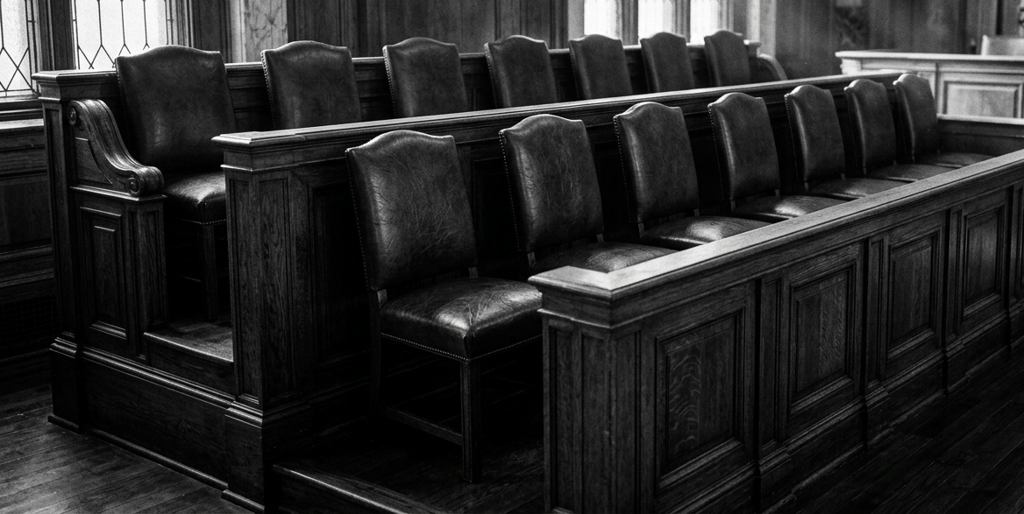
The moment we walked out into the courtroom is something I know I will carry with me for the rest of my life. Everyone standing, waiting for us. It felt like stepping into something already in motion, something larger than any one of us. Up until that point, the idea that I was going to sit on a jury in a murder trial had felt almost unreal, heavy in theory, but distant. And then it wasn’t. It was real. It was immediate. I’ve always believed that jurors are an essential part of our system, that ordinary people are entrusted with extraordinary responsibility. But belief is one thing. Stepping into it is another. As I took my seat in the jury box and looked out over the room at the families, the attorneys, the judge. I felt that responsibility settle in a way that was impossible to ignore.
As both sides gave their opening statements, that weight only deepened. The prosecution laid out a simple timeline, promising that what we would see and hear over the coming days would point clearly to one conclusion. An open and shut case. First Degree Murder. The defense counsel followed, working carefully to introduce doubt, pressing against the idea that the decision was as simple as the prosecution made it out to be.
The responding officers and the detective were among the first witnesses. They spoke about the traffic stop, about procedure, about their interactions with the defendant. Then came the bodycam footage and the formal interview. It’s strange how something so commonly consumed in passing can feel entirely different when you’re responsible for what it means. This wasn’t background noise. This wasn’t something to scroll past. It demanded attention. It demanded presence. I will never forget the moment the footage revealed the body for the first time, the sudden shift in the room, the audible grief from the victim’s family in the gallery, the way the air seemed to tighten. And through it all, the defendant, expressionless, looking up at the screen.
At the same time, there was another part of me that leaned in; the part that is drawn to detail, to process, to understanding how pieces fit together. The expert witnesses fed that part of me. The Crime Scene Investigators took the stand, bringing with them carefully sealed pieces of a night that could never be undone. One by one, they opened those packages and held them up. Among them were gloves, a blanket, the weapon, the fired projectile, even a cinder block. They showed us images of the scenes, walked us through the markers placed in the dark. The Forensic Firearms Examiner followed, guiding us through microscopic comparison images, showing how the smallest markings could tie a projectile back to a specific weapon. It was precise and confident, like watching certainty emerge from something invisible.
The pathologist’s testimony was one of the hardest parts of the trial for me. It was necessary. It was expected. But that didn’t make it easier. The autopsy images were stark, unflinching. The delivery was clinical, measured, almost detached. And yet, for me, that detachment didn’t create distance, it did the opposite. It made everything feel heavier. There was something about the way it had to be presented, the way the process stripped everything down to facts and findings, that made the humanity of it impossible to ignore. It felt, in a quiet way, like the process itself was a quiet condemnation of the act itself.
Of all the witnesses, perhaps none stayed with me more than the defendant’s friend. This was someone who had been there in the lead-up, someone who had been shown the victim, someone who had chosen to call the police. His testimony filled in gaps that had been sitting unresolved, adding context in a way that made the events feel less abstract and more immediate, more real.
And then, just like that, we were at the end of day two. The prosecution rested. The defense chose not to call any witnesses, relying instead on the cross-examinations that had unfolded throughout the trial. And if I’m being honest, they didn’t have much to work with. This was a case where the defendant admitted to what had happened, where the evidence was substantial. But within those limits, they did what they could. They pushed where there was space to push.
We were dismissed early that day so the jury instructions could be prepared and were told to return the next morning.
That afternoon, I was emotionally and physically exhausted. I went home and slept. Whatever I did later to distract myself, it worked well enough. We had been instructed not to talk about the case, not even with each other, and even encouraged not to think about it if we could help it until deliberations. So, each day we would leave our notebooks full of details in the jury room and go back to our lives. I carried the weight of the day with me, but the facts I tried to lock away for when they were needed. The process was important to me.
By Friday, the final day, everything felt closer to resolution. Closing arguments were given. The judge read us our instructions. And then we were led back into the jury room to begin deliberations. The bailiffs brought in all the evidence, including the cinder block that had sat in the backseat of the defendant’s car.
As soon as the door closed behind the bailiffs, the room shifted. Several jurors turned toward me, and Juror #1 asked if I would serve as foreperson. I had quietly hoped to avoid it, but I can’t say I was surprised. A co-worker had joked earlier in the week when I was selected that I’d end up as the foreman. “Damn it… I am, aren’t I?” I laughed back then. And now, standing in that exact, half-predicted moment, it didn’t feel like a joke anymore. I accepted, then turned to the table and began organizing the evidence, settling into the role and preparing to guide us forward.
On the surface, it seemed straightforward. Some jurors questioned whether we even needed to review everything again. But I felt strongly that we did, that we owed it to everyone involved, to the system itself, to be thorough. My mind went back to the families in the courtroom. To the grief we had witnessed. To the uncertainty sitting across from it. This wasn’t something to rush through.
So, we began to dive into the evidence once again. We watched the footage. We reviewed the interview. We looked over the photos. And when we felt ready, we took our first vote. Ten to two, guilty. The defense had reached two people. And I understood why.
But for the rest of us, there were parts of the case that remained solid. So, we kept going. We talked through it. We asked questions. We circled back. The votes stayed the same.
There was one moment that seemed to slow everything down. I caught myself stepping back, just enough to really see what was happening in that room. Twelve strangers, packed into a tight space, leaning into a conversation that carried real weight, voices rising, pausing, circling back, each of us coming to a decision that would ripple far beyond those walls. It wasn’t lost on me what we were being asked to do.
And what stood out most was this: everyone showed up. No matter how quiet or reserved they had been throughout the week, they found their voice in that room, even the elderly woman in the tenth seat, who spoke with a kind of intention that made you listen. Over the course of the trial, it had already been clear that we were a mix of perspectives, a small cross-section of the world outside. But in that moment, during deliberations, something sharper came into focus. They were taking it just as seriously as I was. And for a brief moment, amid all that weight, there was something grounding about that.
At one point, I found myself leaning into what I know, talking about the brain, about stress responses, even using Dr. Siegel’s hand model to explain how people react under stress. It felt a little out of place, but also necessary. In the end, it all helped. One of the holdouts began to shift, to see the case differently. And once that happened, something changed in the room. We kept returning to her perspective, letting it guide the conversation.
I can’t say for certain, but it felt like her willingness to reconsider gave the final holdout space to do the same. It took time, just over three hours, but eventually, we reached a unanimous decision. And more importantly, it felt like we had done it the right way.
Once the verdict form was completed, everything moved quickly. We gathered our things. I carried the electronics and the forms back into the courtroom, confirming they were correct as I handed them to the bailiff. I was grateful I didn’t have to read the verdict aloud. I don’t know if that’s just a TV thing, but in that moment, I was thankful for it.
When the verdict was read, my heart was pounding. It didn’t slow as we were escorted out, didn’t slow as we walked to our cars, didn’t slow until I was blocks away from the courthouse.
I don’t regret the decision we made. But I don’t take lightly what it meant. The weight of it. The impact of it. I’m grateful that my place in that room was in the jury box and not in the gallery. And I believe that, as a jury, we approached it with the seriousness it deserved. We took the time. We did the work. We honored the responsibility placed in front of us.